In search engine optimization and website information architecture, the URL slug is frequently treated as an afterthought. Content management systems often auto-generate slugs directly from long headlines or assign arbitrary database keys (e.g., /p=8492). However, search engine crawlers evaluate URL strings directly to establish topical relevance and understand site hierarchy. For human searchers scanning search engine results or shared links on social media, a clear, descriptive URL signals credibility and drives higher click-through rates.
In this guide, we outline the foundational principles of URL slug architecture, examine common implementation mistakes, and demonstrate how to write clean, high-ranking web addresses.
The Seven Golden Rules of SEO-Friendly URL Slugs
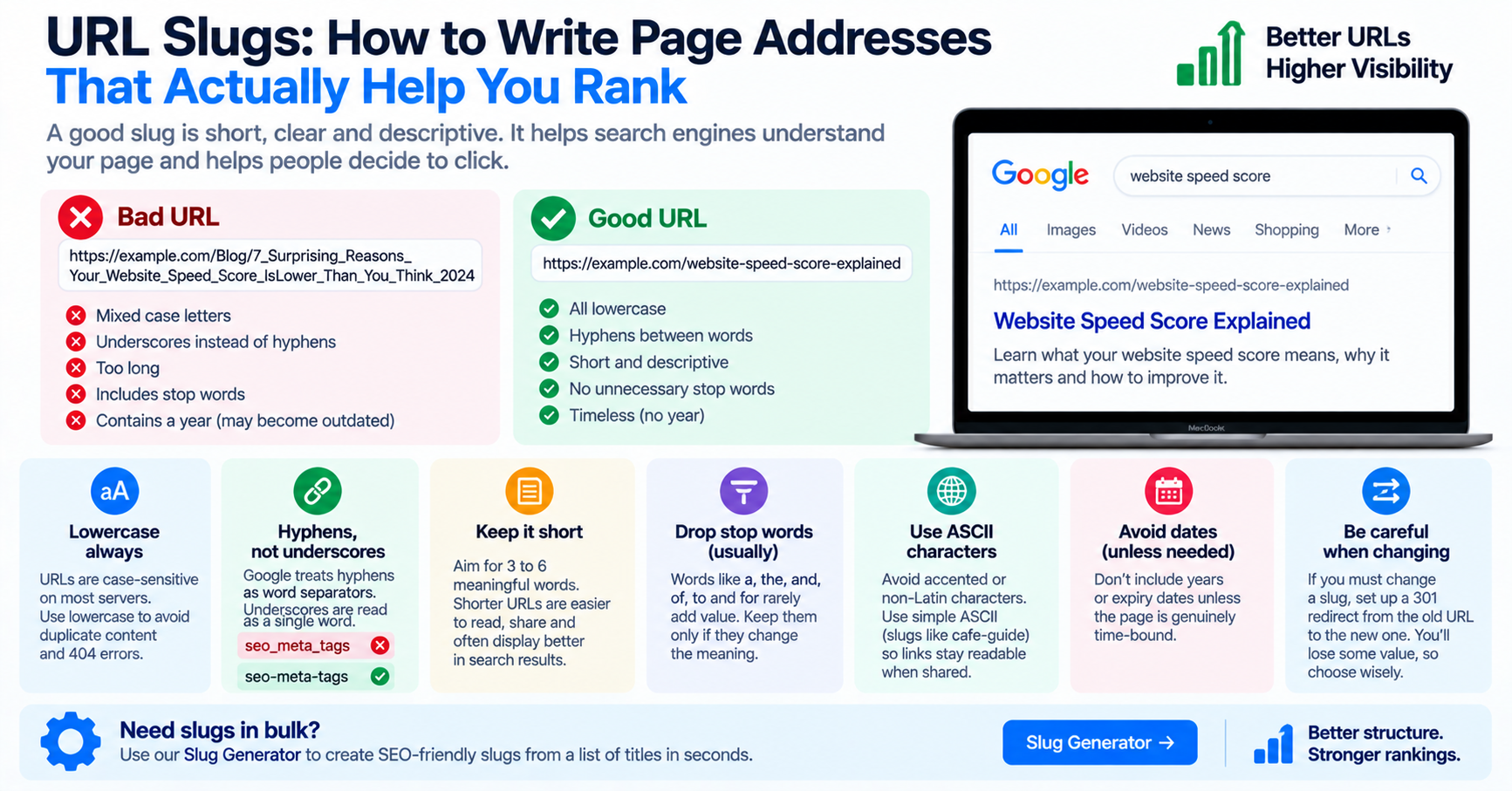
| Rule | Substandard URL | Optimized Slug | Technical Rationale |
|---|---|---|---|
| 1. Use Hyphens Exclusively | /seo_tools_guide |
/seo-tools-guide |
Google's search documentation explicitly confirms that hyphens separate words; underscores join words. |
| 2. Enforce Strict Lowercase | /Blog/SEO-Guide |
/blog/seo-guide |
Linux web servers treat uppercase and lowercase URLs as distinct endpoints, causing duplicate content. |
| 3. Eliminate Stop Words | /the-best-guide-to-the-seo |
/best-seo-guide |
Words like a, the, in, of, and dilute topical keyword density without adding semantic value. |
| 4. Strip Date Stamps from Evergreen URLs | /2023/11/best-tools |
/best-tools |
Embedding dates in slugs makes updated evergreen content appear outdated in search results. |
| 5. Keep Length Under 60 Characters | 15-word title auto-slug | 3 to 5 core keywords | Short URLs are easier to share, scan on mobile devices, and remember. |
Information Architecture: Click Depth & Siloing
A well-architected URL slug reflects the logical parent-child taxonomy of your website. Search engines utilize hierarchical URL paths to understand the topical relationships between broad category hubs and granular sub-pages:
https://tuwebtools.com/tools/category/developer
https://tuwebtools.com/tools/json-formatter
Keep your folder nesting shallow. A URL structure that requires five nested directories (e.g., /blog/archive/2026/tech/guides/article-title) signals to search engines that the page is buried deep in the site architecture, potentially reducing crawl priority.
301 Redirect Rules: Preserving PageRank When Renaming Slugs
If you must modify an established URL slug on an existing page that already has search engine rankings and backlinks, always implement a permanent HTTP 301 Redirect immediately. Failing to set up a 301 redirect wipes out accumulated PageRank authority and leaves search visitors on a 404 error page:
# Apache .htaccess 301 Redirect Rule
Redirect 301 /old-messy-article-slug /clean-seo-slug
Generate clean, standardized, hyphenated URL slugs instantly using our free client-side Slug Generator.