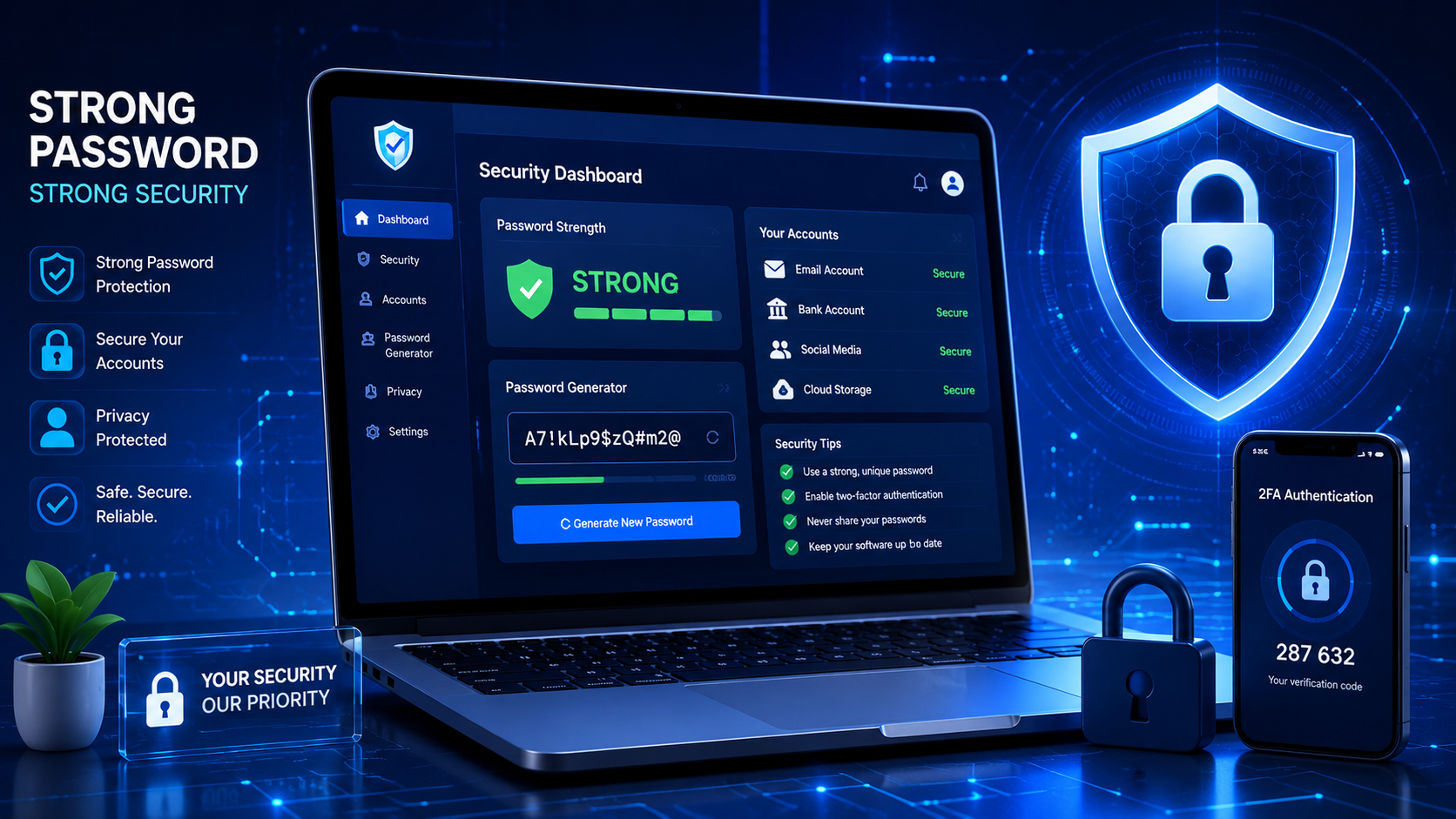
For over two decades, corporate IT policies and web application registration forms enforced rigid password complexity rules: minimum 8 characters, at least one uppercase letter, at least one numeral, and at least one special symbol. Users responded to these rules in predictable ways: appending ! to the end of a dictionary word, replacing the letter E with 3, or capitalizing only the first letter (e.g., P@ssword1!).
Modern cyber adversaries do not guess passwords character by character; they utilize distributed GPU clusters running Hashcat and John the Ripper to test trillions of candidates per second using customized rule masks and leaked breach dictionaries. Recognizing this operational reality, the National Institute of Standards and Technology (NIST) fundamentally revised its digital identity guidelines in NIST Special Publication 800-63B.
The Mathematics of Password Entropy
The cryptographic security of a credential is measured in information entropy bits ($H$). Entropy quantifies how many brute-force guesses an adversary must calculate in the worst-case scenario to guarantee discovering the secret:
$$H = L \times \log_2(N)$$
Where $L$ is the password length in characters, and $N$ is the size of the character pool (alphabet size):
- Lowercase letters only ($a–z$): $N = 26 \implies \log_2(26) \approx 4.7$ bits per character
- Mixed-case letters ($a–z, A–Z$): $N = 52 \implies \log_2(52) \approx 5.7$ bits per character
- Alphanumeric ($a–z, A–Z, 0–9$): $N = 62 \implies \log_2(62) \approx 5.95$ bits per character
- Full ASCII Printable ($94$ symbols): $N = 94 \implies \log_2(94) \approx 6.55$ bits per character
Offline GPU Brute-Force Cracking Speeds (8x NVIDIA RTX 4090)
To understand why password length dramatically outperforms character complexity, consider the time required to exhaust a character keyspace using an off-the-shelf 8x RTX 4090 GPU cracking cluster running at 800 GH/s ($8 \times 10^{11}$ hashes/sec) against fast MD5 or NTLM hashes:
| Password Example | Length & Type | Entropy Bits | Total Keyspace | Time to Crack (8x RTX 4090) |
|---|---|---|---|---|
Tr0ub4dor& |
10 chars (Complex) | ~35 bits (Rule mask) | $5.4 \times 10^{19}$ | Under 3 days (Dictionary rule) |
7k#9Q$mP2!xL |
12 chars (Random full ASCII) | ~78.6 bits | $4.7 \times 10^{23}$ | ~18 years |
correct-horse-battery-staple |
28 chars (4-word passphrase) | ~52 bits (Diceware) | $3.6 \times 10^{15}$ (words) | Centuries against offline dictionaries |
xK9#mQ2$vL8!pZ4@rW1* |
20 chars (CSPRNG Random) | ~131 bits | $2.9 \times 10^{39}$ | Unbreakable (Trillions of years) |
Key Recommendations from NIST SP 800-63B
- Prioritize Length Over Complexity: Encourage passphrases of at least 15 to 20 characters. Length provides exponential entropy growth ($N^L$).
- Abolish Mandatory Periodic Expiration: Forcing users to change passwords every 90 days encourages predictable increments (e.g.,
Spring2026!→Summer2026!). Passwords should only be changed upon suspected compromise. - Screen Against Leaked Breach Dictionaries: Services must check new passwords against compromised password databases (such as Have I Been Pwned).
- Mandate Multi-Factor Authentication: Pair strong passwords with TOTP or FIDO2 hardware security keys.
Interactive Security Checklist
- [ ] Generate high-entropy credentials using our browser-native Password Generator.
- [ ] Evaluate existing credentials using our client-side Password Strength Checker.
- [ ] Store credentials in an audited password manager (Bitwarden, 1Password) rather than browser auto-fills.