Every web developer has encountered broken hyperlink bugs that defy immediate explanation: an authentication redirect terminates on a 404 error page, a search query truncates half of the user's keywords, or a cloud file storage API throws an invalid resource path exception. The root cause of these issues almost universally traces back to improper URL Encoding (Percent-Encoding).
The World Wide Web relies on Uniform Resource Identifiers (URIs) to route requests to specific servers and resources. However, URIs are governed by rigid structural rules codified in IETF RFC 3986. Failing to distinguish reserved structural characters from literal data parameters creates critical routing bugs. In this technical guide, we break down how percent-encoding functions, explore common pitfalls, and demonstrate robust encoding practices across languages.
The Architecture of RFC 3986 Percent-Encoding
RFC 3986 strictly partitions all ASCII characters into three functional categories:
| Character Set | Characters Included | Encoding Requirement |
|---|---|---|
| Unreserved Characters | A-Z, a-z, 0-9, -, _, ., ~ |
Never encoded; transmitted literally in all contexts. |
| Reserved Characters | :, /, ?, #, [, ], @, !, $, &, ', (, ), *, +, ,, ;, = |
Must be percent-encoded when appearing as literal data inside parameters. |
| Illegal Characters | Spaces, control characters, non-ASCII Unicode (e.g. café, emojis) |
Always serialized into UTF-8 bytes and encoded as percent-triplets (%HH). |
The Space Ambiguity: Plus (+) vs. %20
One of the most persistent quirks across the web is how spaces are encoded in URLs:
- RFC 3986 Path Standard (
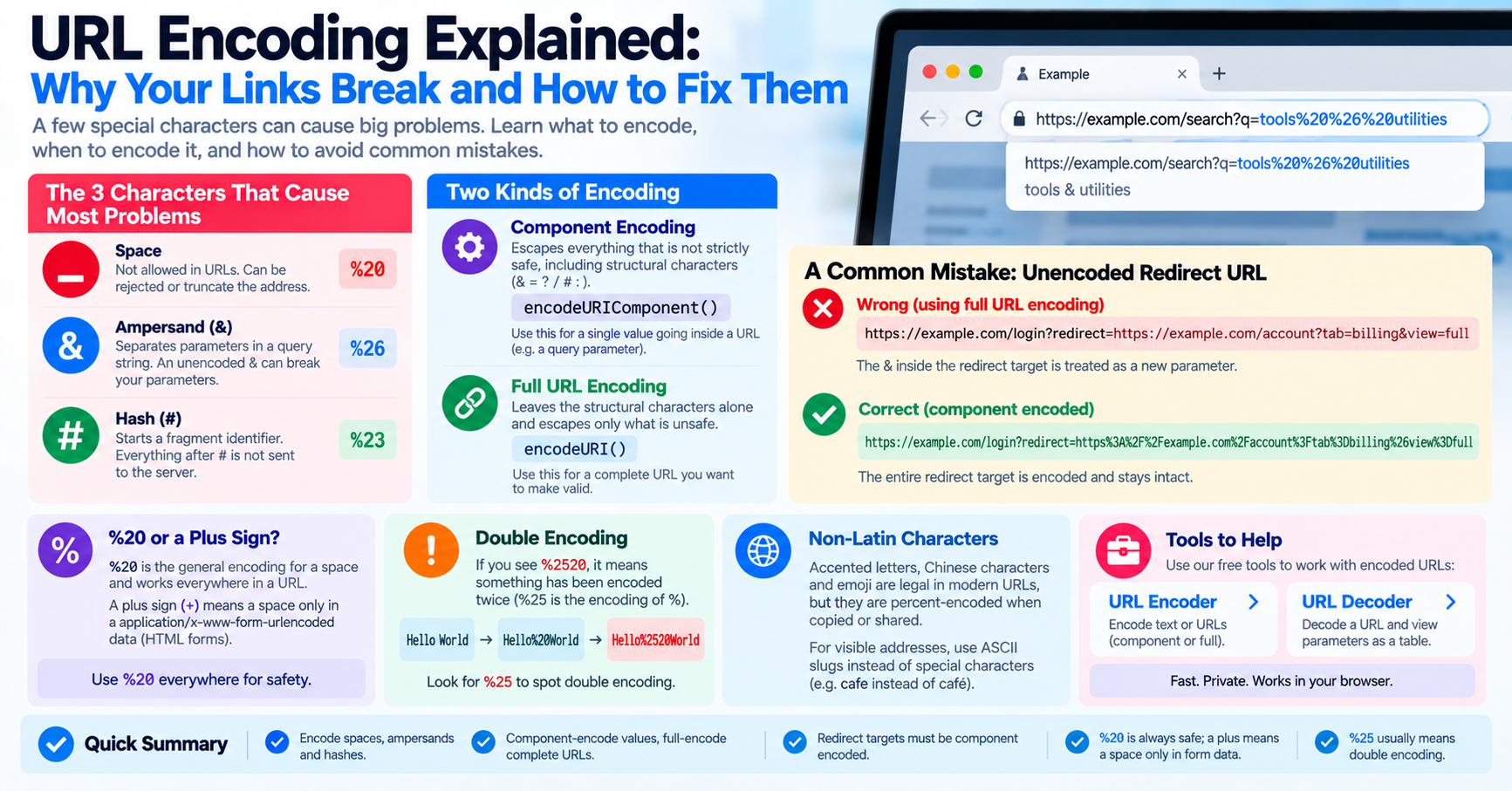
%20): In the path component of a URL (e.g.,/blog/web%20performance), a space must always be encoded as%20. If you write/blog/web+performance, the web server treats the plus sign literally, looking for a file or slug containing an actual plus sign. - HTML Form Standard (
+): In query string parameters adhering to theapplication/x-www-form-urlencodedspecification (historical HTML forms), spaces were historically replaced with plus signs (?q=data+science).
Modern REST API design strongly recommends standardizing exclusively on %20 across both paths and query parameters to avoid interpretation bugs across web servers (Nginx, Apache, LiteSpeed).
The Anatomy of the Double-Encoding Bug
One of the most insidious bugs in web applications is double-encoding. This occurs when an already-encoded URL is mistakenly passed through an encoding function a second time:
- Original string:
"search term" - First encoding pass:
"search%20term"(The space becomes%20). - Second accidental pass:
"search%2520term"(The%character is encoded to%25).
When the backend server receives search%2520term and decodes it once, it yields literal search%20term rather than the original user query, corrupting search filters and database lookups.
Programmatic Encoding Comparison
// JavaScript: The Critical Difference
const query = "https://example.com/search?q=C++ & Python";

// WRONG: encodeURI preserves '&' and '+' as structural delimiters
console.log(encodeURI(query));

// RIGHT: encodeURIComponent encodes individual parameter values
const base = "https://example.com/search?q=";
const param = encodeURIComponent("C++ & Python");
console.log(base + param);
// Output: https://example.com/search?q=C%2B%2B%20%26%20Python
Encode and decode URLs, query strings, and OAuth redirects instantly using our free client-side URL Encoder and URL Decoder.